From awareness to responsibility: Why each of us should think of Timmy the next time we buy fish.
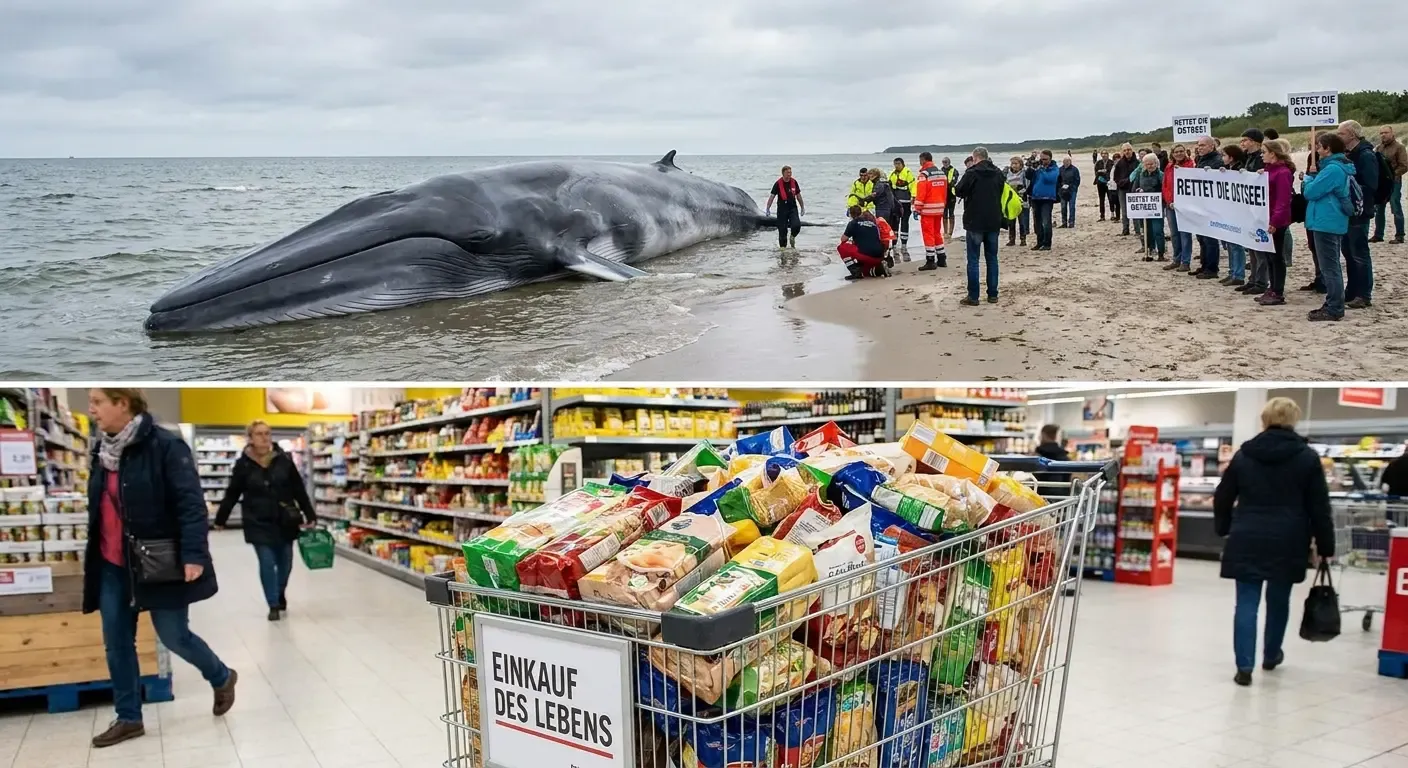
Since the beginning of March 2026, a humpback whale has been keeping Germany on edge. First spotted in the port of Wismar, “Timmy,” also affectionately called “Hope,” had become entangled in a net and was rescued. Since then, volunteers, veterinarians, politicians, and the entire nation have been emotionally fighting for him. Human chains, rescue boats, sandbags, drones. Everything is being tried to save this one animal.
That’s beautiful. And it’s a good thing.
But it also confronts us with an uncomfortable question: Why are we so deeply moved by a single whale, while every day we buy products that systematically kill whales and dolphins?\
What connects Timmy with our everyday life
Timmy’s story is not just a natural spectacle. It is also a mirror. According to Wikipedia, his appearance on German coasts is a sign of the partial recovery of humpback whale populations – the result of decades of international protection measures and the moratorium on commercial whaling. Protection has worked.
At the same time, Timmy may be dying from exactly what happens every day: fishing nets.
His first appearance: he had become entangled in a net.\
Bycatch: The Invisible Catastrophe
Bycatch is the leading cause of death for marine mammals worldwide. What few people realize: with every fish stick, every can of tuna, every shrimp cocktail, this silent mass dying can be co-financed.
What exactly is bycatch? When fishing with large nets (trawl nets, gillnets or purse seines), it’s not only the target fish that end up in the net. Whales, dolphins, sea turtles, sharks and seabirds are also caught. Many die in agony because they can no longer surface or are injured by the pressure of the net.
Particularly dramatic: the death of a single whale can destabilize an entire family group. Whales live in close social units. If the experienced matriarch, who knows the best feeding grounds, dies, the entire group suffers.\
The MSC label: No free pass for whales
Many consumers trust the blue MSC label (Marine Stewardship Council) as a guarantee of sustainable fishing. The problem: even MSC-certified products do not guarantee adequate whale protection.
According to a study by NABU and BirdLife International, only 13% of the MSC-certified fisheries examined received a good rating on the issue of bycatch. For the overwhelming majority, the unwanted bycatch rates of whales, dolphins and other threatened species did not even decrease after certification.
The Whale and Dolphin Conservation organisation (WDC) is also clear: MSC certifications do not guarantee that whales and dolphins did not suffer or die during the catch.\
Which fish products are particularly problematic?
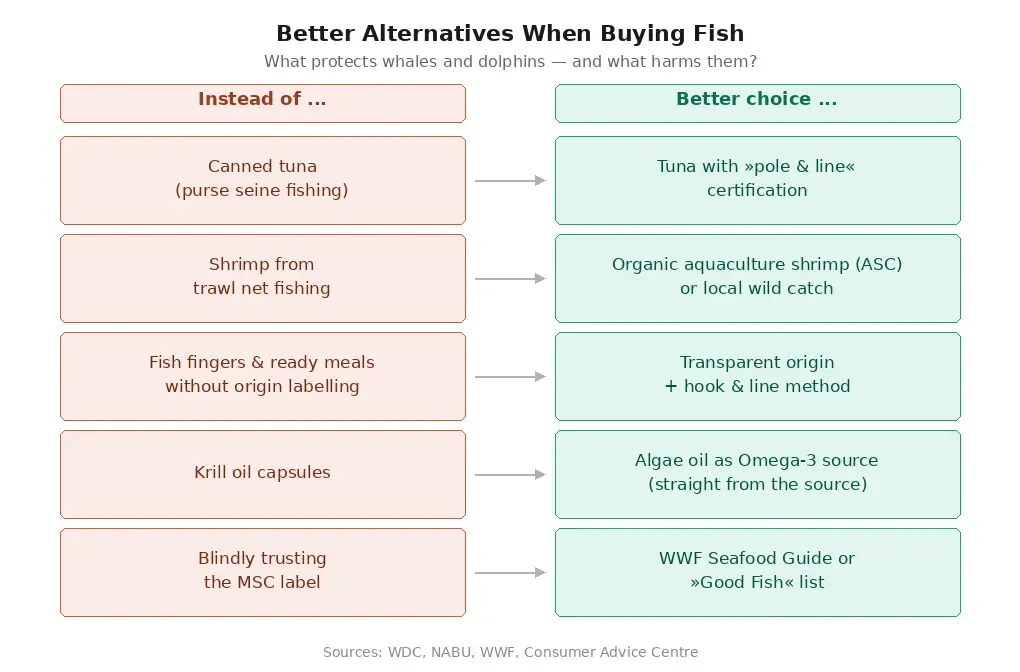
These products and fishing methods are particularly under criticism:\
🚫 Avoid or question
- Tuna from purse seine nets (often canned). High dolphin bycatch; even MSC-certified fisheries in the Mexican Pacific have been criticized
- Prawns and shrimpEspecially from trawl fisheries using bottom trawls, which also destroy the seabed; in addition: North Atlantic prawn and lobster fisheries demonstrably contribute to the decline of the North Atlantic right whale
- **Fish sticks, breaded fish and convenience products.**Here, the origin and fishing method are often not declared.
- Krill products (dietary supplements, omega-3 from krill). Krill is the main food source for whales; fishing it literally deprives them of their means of survival
- Gillnet fishing in the North and Baltic Seas. According to WDC, very likely associated with negative impacts on harbour porpoise populations
What can we do? The good news
Consumption plays a part in the decision. And this is where smantry becomes relevant: anyone who shops consciously, wastes less, and deliberately chooses alternatives is already doing a lot.\
📱 How the Smantry app helps
When you use Smantry to plan your food and avoid leftovers, you automatically reduce your footprint – including on the oceans. Anyone who plans more consciously shops more purposefully, chooses plant-based proteins more often, and takes a second look at the label when buying fish.
Tip: Use Smantry to replace fish meals more often with sustainable alternatives, e.g. legumes, mushrooms or tofu as the main protein source, and save fish for moments when you really know what’s in it.\
The conclusion: Timmy as a turning point?
Millions of people have been rooting for Timmy in recent weeks. This shows how deep our connection with these fascinating animals is. Now it’s time to turn this feeling into action.
Because while Timmy’s rescue is in the spotlight, whales and dolphins are silently dying in nets every day. Without a name, without a hashtag, without a live blog.
Let’s make sure that the empathy we feel for Timmy doesn’t end with his fate, but begins with our next purchase.
Read this articles as well:
Cooking without shopping: recipes from the pantry
Quiet Saving: The new saving trend without sacrifice
How to optimize food storage – clever hacks for your pantry
Sources & further links:\
Read next